
Fields in Petersburg Property Tax Records
Think of the Land Book as the city's annual assessment roll. Petersburg says it carries each parcel's owner name, legal description, assessment, and taxes levied. The parcel viewer layers on land, improvement, and total value filters. It also adds use, zoning, acreage, sale-date, and subdivision fields. A bill is different. It is an account record. It shows what Collections seeks for a period and whether a payment or delinquency has been recorded.
| Field | What It Shows | Where |
|---|---|---|
| Land Book assessment | Owner, legal description, assessed value, and taxes levied | City Assessor |
| Land and improvements | Separate value components and a total-value filter | CivQuest / Assessor |
| Exemption entry | Any exemption recorded on the parcel roll | City Assessor; confirm eligibility directly |
| Bill and payment | Installment amount, payment status, or delinquency | Collections / Treasurer |
| Tax-sale notice | Published collection or sale information | City Collections |
An assessed value exists for taxation. It is not a recent sale price. Petersburg's assessment program applies sales-comparison, income, and cost approaches in mass appraisal. A recorded consideration belongs to a deed or transfer record instead. The bill, meanwhile, reflects only the tax account for its billing period. Match the same parcel across all three by its map number. The city's Land Book and assessment page lays out this assessor context. It also clarifies which office owns a value question.

The annual roll and the biennial reassessment schedule are related events, but they are not the same thing.
Petersburg's Biennial Reassessment
Petersburg reviews all real estate every two years, even though a Land Book is created each year. Values are set as of January 1 and become effective July 1. The city says its mass appraisal may use sales-comparison, income, and cost approaches. A parcel's value can change when market evidence shifts or when construction, demolition, rezoning, or corrected property data changes the record.
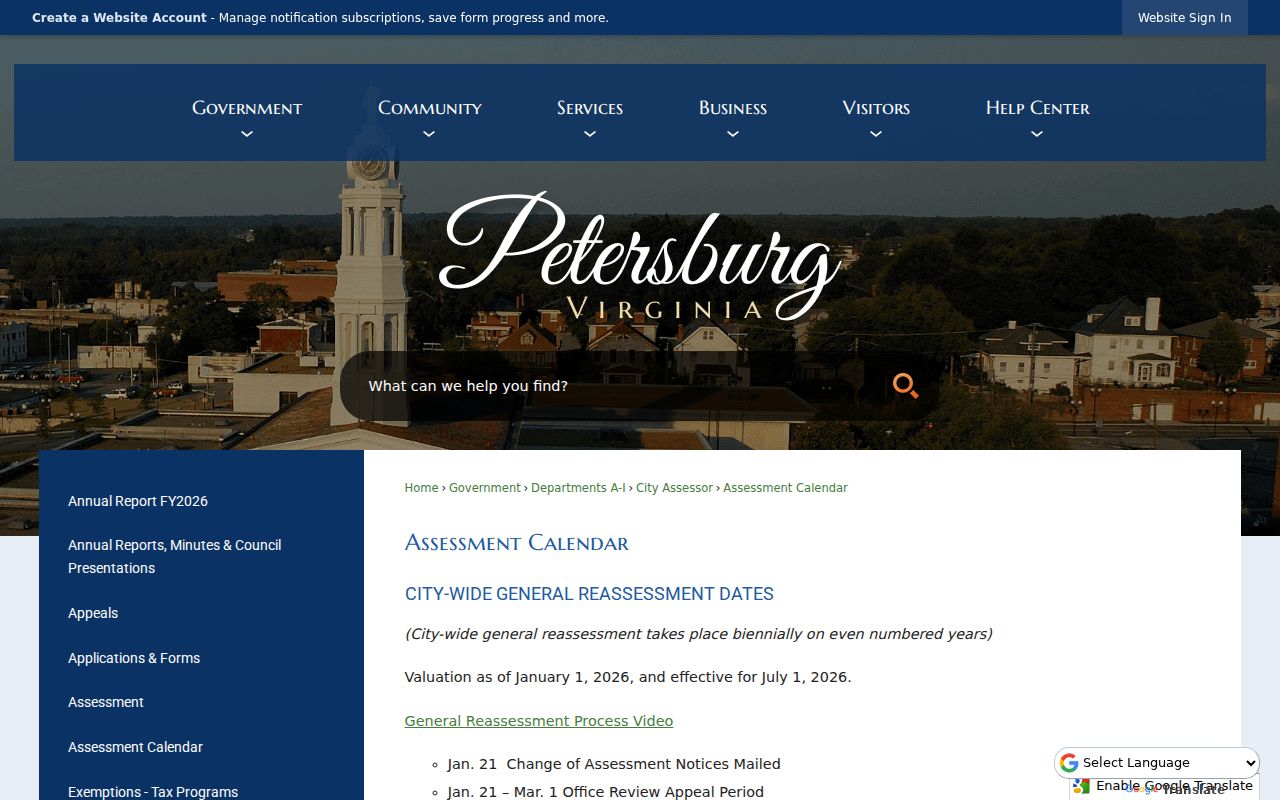
The 2026 calendar identifies January 1, 2026 as the valuation date and July 1 as the effective date. It lists Office Review from January 21 through March 1, Board of Equalization appeals from January 21 through April 1, Land Use applications by May 31, and hearings in May and June. Those dates are historical for the 2026 cycle. The next calendar should be checked before relying on a deadline.
Finding a Petersburg Tax Bill
Start with the property's map number whenever you can. The city payment FAQ says real estate should be identified by map or parcel number. If only an address is known, use CivQuest to pin down the parcel first. Then carry that number into the tax-payment route. Keep the bill year and installment with the result. One amount due does not tell you whether earlier quarters were paid.
- Find the parcel's complete map number in the City Assessor's CivQuest card.
- Open the city's tax-payment route and enter the map number, checking the account and billing period.
- Compare the bill to the Land Book assessment and any listed exemption.
- For a delinquency or sale notice, contact Collections and confirm the parcel and legal description.
- Assessed value
- The value entered on the city roll for tax purposes.
- Land Book
- The annual city record of parcels, owners, descriptions, assessments, and taxes levied.
- Installment
- One part of the quarterly real-estate payment schedule.
- Tax lien
- A claim associated with unpaid taxes; check the recorded and collection records for its status.
The city's payment FAQ lists online payment, mail, a drop box, and counter service. Electronic check carries no convenience fee. Credit cards carry a 3 percent fee. Online portal hours run 4 a.m. to 11 p.m. Counter hours differ between the FAQ and the Collections page, so confirm before visiting. The payment options and the map-number instruction appear in the city's quarterly payment FAQ.
A payment record confirms an account transaction, not the current title holder.
Quarterly Petersburg Tax Payments
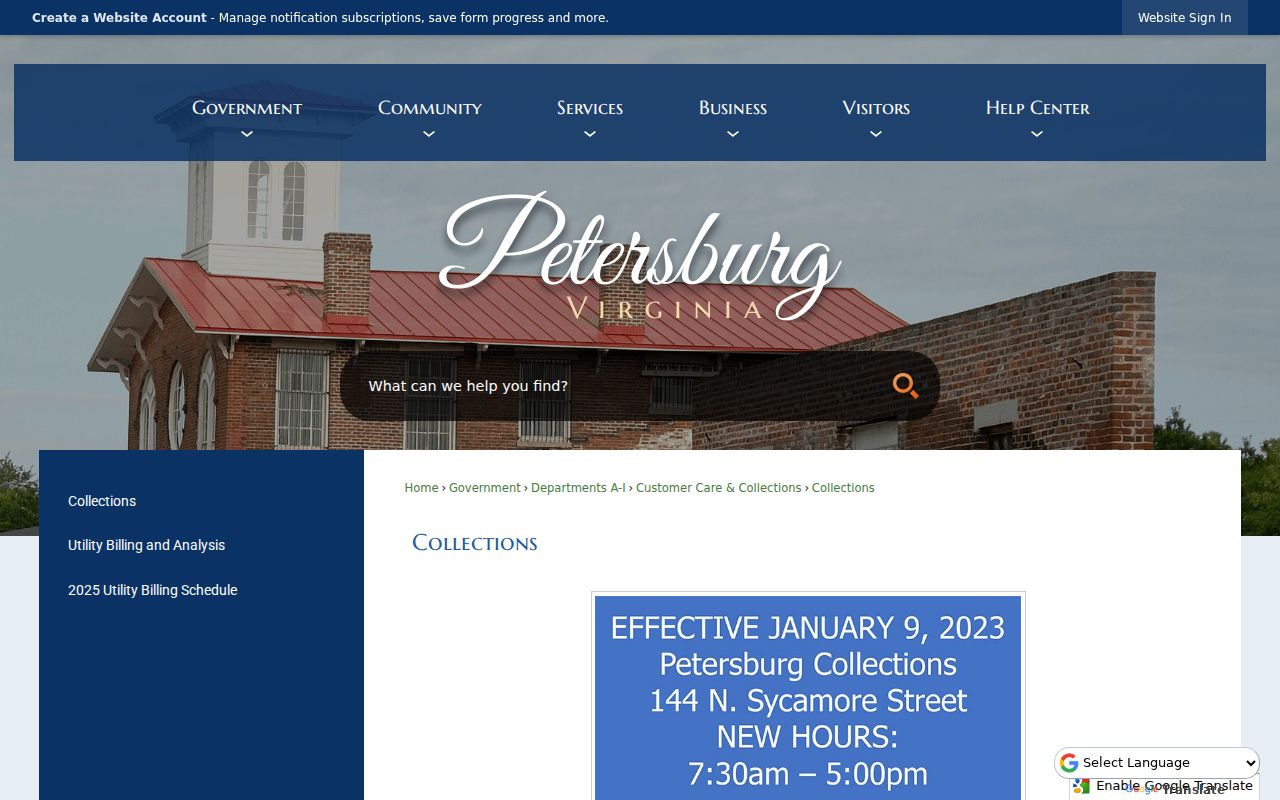
Real-estate installments fall on September 30, December 31, March 30, and June 30. Keep the parcel number and payment confirmation for each quarter. If the account does not show a payment, ask whether the transaction is pending, posted to another period, or tied to a different map number. Collections lists separate contacts for collection and payment questions. The Collections office sits at 144 N Sycamore Street and publishes 804-733-2346; the Treasurer number is 804-733-2322. Published hours differ across city pages, so call before going in person. The Collections page describes current and delinquent accounts as well as tax-sale information.
Ask the city to confirm current collection steps, because a notice or portal can change without much warning.
Office Review and Board Appeal Dates
The 2026 assessment calendar covers two separate routes. One is an Office Review. The other is an appeal to the Board of Equalization. The city lists the former from January 21 to March 1. The Board route runs from January 21 to April 1. Hearings take place in May and June. A Land Use application deadline of May 31 is also listed. Read the calendars and linked forms together. An assessment dispute and a land-use application are distinct processes. For a review, gather the parcel card and the notice. Add dated photos, measurements, and relevant sales or property facts. Explain which characteristic or comparison appears wrong, and keep a copy of every submission. The city publishes no deadline beyond the 2026 dates. Do not treat those dates as a standing annual rule. The dated Petersburg assessment calendar is the source for that cycle.
Use the current posted calendar to verify any future filing window.
Petersburg's 2025 Bill Correction
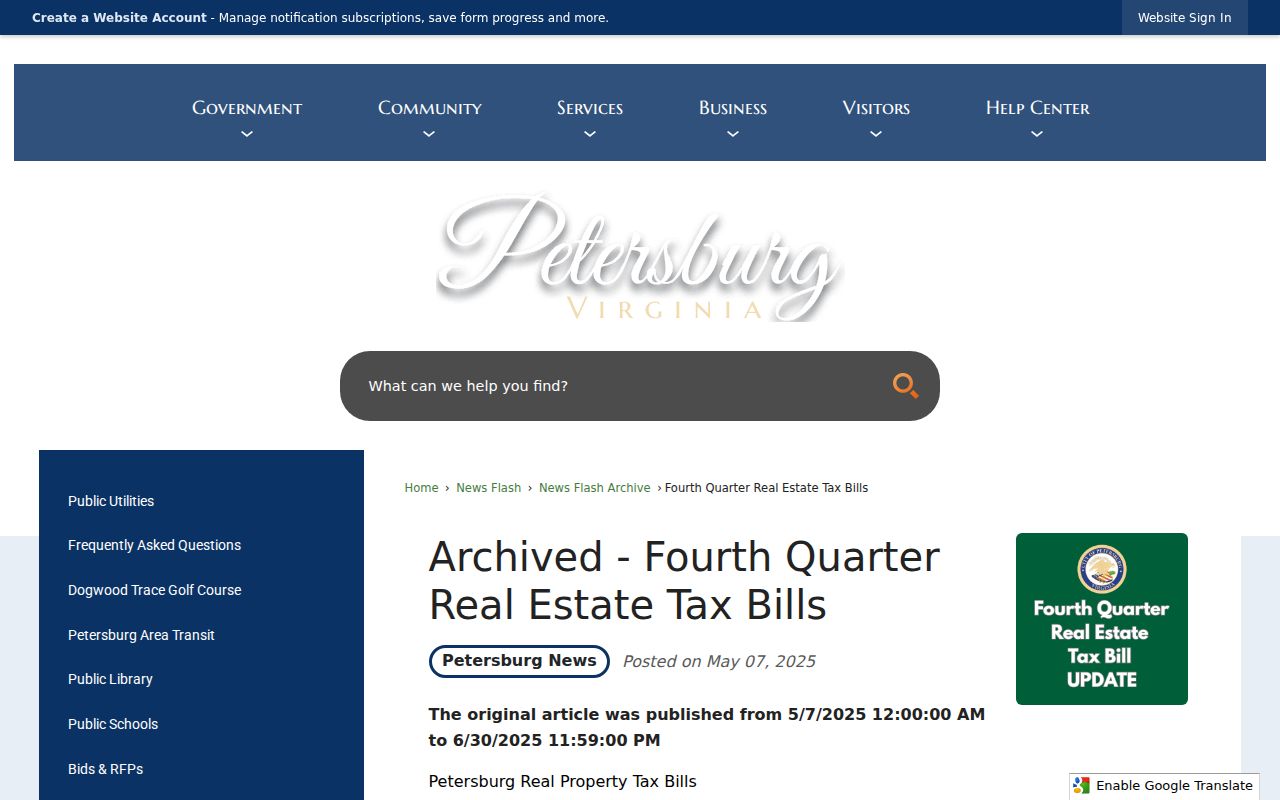
Petersburg mailed roughly 500 fourth-quarter real estate tax bills to the wrong people in the spring of 2025. Collections had worked from an incorrect file, and some addresses were wrong too. The city sent replacement bills and asked recipients to ignore the first notice. The episode is worth remembering. A tax mailing label is not the same thing as the deed. It is not the assessor's owner of record field either.
Suppose a bill arrives addressed to a prior owner. That alone does not mean the parcel changed hands. Pull the latest recorded instrument. Compare the owner field on CivQuest. Ask Collections to confirm the account and billing period. The city's correction notice documents both the error and the response.
A deed, a Land Book entry, and a payment account each update on its own schedule.
Reconcile a Petersburg Tax Bill to Its Parcel
Match the bill before paying it or disputing it. Compare its map number to the CivQuest parcel card. Check the tax period printed on the notice too. Petersburg identifies real estate by map or parcel number, so that number is the anchor for everything else. Keep the bill, the payment confirmation, the account history, and the parcel card together, because an address can be formatted differently or point to a mailing location rather than the taxable site. If a payment seems to have vanished, ask Collections whether it is pending, posted to another quarter, or tied to a different map number.
The city's payment FAQ covers online payment, mail, a drop box, and counter service. Electronic check carries no convenience fee. Credit cards cost three percent. Portal access runs from 4 a.m. to 11 p.m. The FAQ and the Collections page give different counter-hour details, so confirm current hours before traveling. Quarterly due dates are September 30, December 31, March 30, and June 30. Save the transaction confirmation and note which installment it covered.
Separate a balance question from a value question. Collections handles the tax account and posted payments. The Assessor maintains the assessment and Land Book. A recorded deed settles any question of conveyance. Petersburg's 2025 corrected-bill notice shows why a mailing label proves nothing about current ownership, since about 500 fourth-quarter bills went to former owners after a bad file was used. Match the parcel, the period, and the record type before acting on any mismatch.
Delinquent Petersburg Tax Accounts
Collections publishes tax-sale information and points people to the delinquent property collector for upcoming auctions. The city posts no stable search table for delinquent accounts. There is no complete parcel list, no posted terms, and no sample result. Treat an auction notice as a lead, nothing more. Verify the map number, legal description, and sale date with the city. Confirm the minimum bid, deposit, costs, and post-sale rules with the published sale agent. Do this before relying on any of them.
A delinquent account does not mean title has transferred. For a sale or foreclosure, follow the notice through the court file. Trace it to the recorded conveyance. The final order or trustee deed is the document to find, so confirm it in the land index. The tax account answers one question. The recorded deed answers another. Both may describe the same property.
How a Petersburg Assessment Is Challenged
Petersburg assesses property through mass appraisal. A challenge works best when it attacks a specific fact about the parcel. Point to a wrong characteristic, a measurement problem, or market evidence. Simply arguing for a lower price rarely moves the review. Gather your parcel number, the assessment notice, photos, and comparable property records before you start. Comparable citations carry weight. The review route and the Board route each follow distinct steps and windows. Track which deadline applies to your appeal.
Appeal window. The published 2026 Office Review and Board dates have passed. Confirm the next calendar and filing instructions with the City Assessor before sending an appeal.